Extreme readings arrive in clusters
August 7, 2026
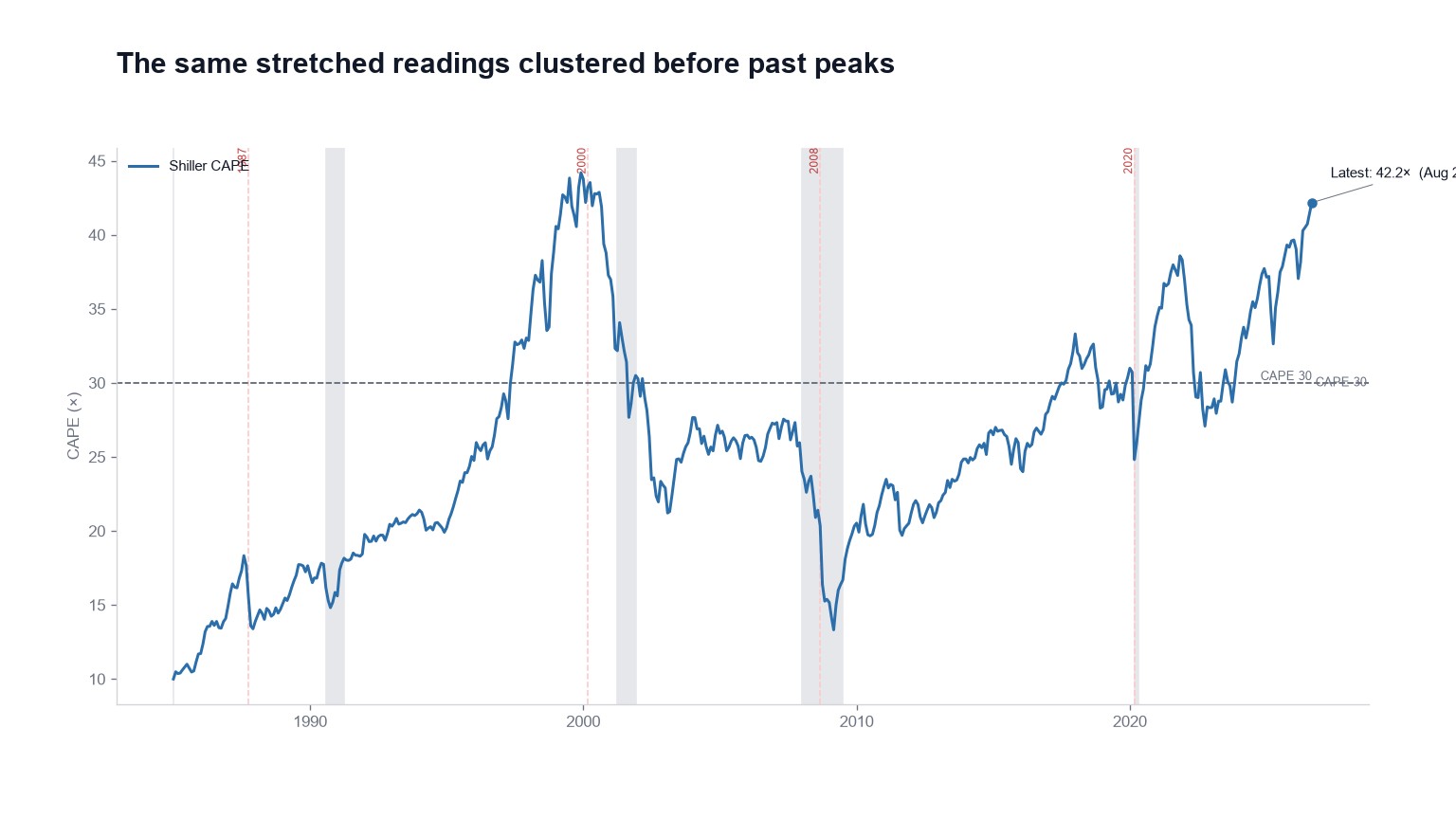
Zoom Shiller CAPE to the modern era and the shape is hard to miss. Readings above 30 were genuinely rare before the late 1990s. Then they bunched into 2000, bunched again into 2021, and they're bunched now at 42.17×, with the composite overvaluation probability at 93%.
Most crashes aren't valuation crashes
Four crash marks sit on this chart and only one lines up with a valuation extreme, which is worth being honest about.
October 1987 was a single day of liquidation at a CAPE that was elevated but nowhere near a record. 2008 was credit and housing; CAPE had already fallen a long way from 2000 and then got considerably cheaper. 2020 was a virus and a shutdown. The crash lines don't claim otherwise, since they mark drawdowns rather than causes.
So the clusters, not the crashes, are the part of this chart that belongs to valuation. 2000 and 2021 were both episodes about price relative to a decade of earnings, and so is 2026. Line the present up against 2000 on Buffett, Tobin's Q and household equity and today is worse in several columns, with Excess CAPE Yield as the column where it isn't.
What a cluster is worth
Two things, and they pull in opposite directions.
First, an extreme CAPE is a condition rather than a moment, and conditions last. The late 1990s made that case for three straight years at considerable expense to anyone who acted on the first high reading.
Second, when each of those conditions eventually broke, the ten years of real returns measured from those starting points landed in the weakest bucket of the forward-return table.
Both are true at once. Clusters run longer than people expect, and they still cost something. That's an uncomfortable pair of facts to hold, and any framing that drops one of them is selling you something.
Use the cluster as context for a 93% composite rather than as a date. The homepage updates as the data does, and the line is still up here.