2000 answers one question, not four
August 27, 2026
Everyone reaches for March 2000, and it's a fair instinct. CAPE peaked near 44, the Nasdaq stopped behaving like a market and started behaving like a story, and the decade of real returns that followed was miserable.
The mistake is treating "are we at 2000?" as though it has a single answer. Run four gauges instead of one and the comparison splits apart.
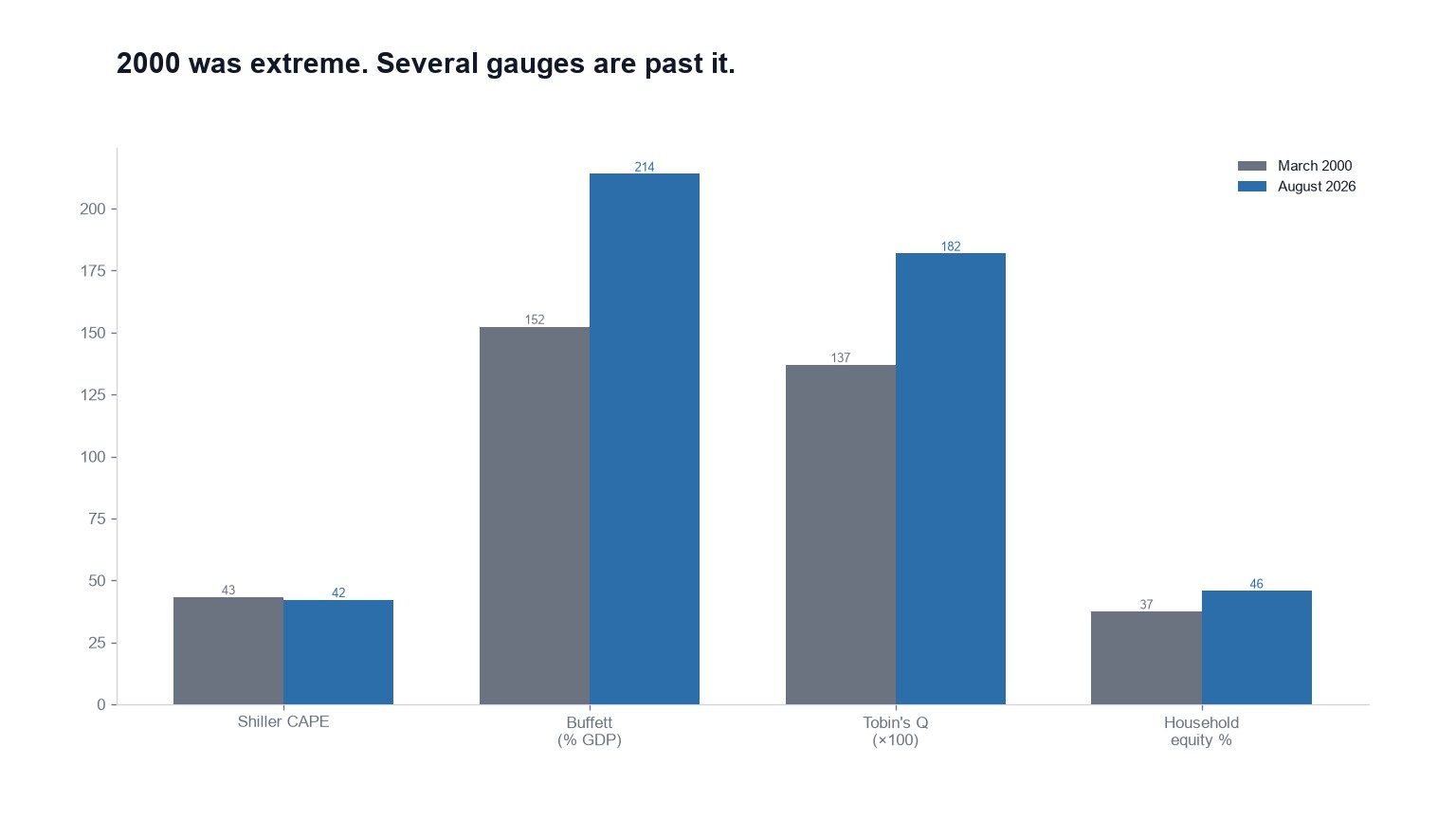
CAPE is 42.17× today, a shade under the peak. The Buffett Indicator is 214% of GDP against roughly 152% in March 2000. Tobin's Q is 1.82 against about 1.37. Household equity allocation is 45.8% against something near 37%.
One column is comparable. Three are worse.
The earnings are real this time
That objection is mostly true and it matters. 1999 was unprofitable technology trading at absurd multiples of revenue. Today's concentration is profitable mega-cap AI trading at high multiples, sitting on top of an index that was already expensive before those companies got large.
It's a good reason to think any eventual unwind won't rhyme with the last one. Different companies fail in different ways, and a business with real cash flows doesn't go to zero the way a 1999 story stock could.
It's a much weaker reason to conclude the overall price is sensible. Buffett and Q have passed their 2000 readings precisely because this isn't one hot corner of the market. It's the whole market, large against national output and large against what the underlying assets would cost to replace.
Globalization and intangible assets bias both of those ratios upward compared with 2000, and we say so on the indicator pages. Grant the adjustment and each gauge is still Strongly Overvalued or Overvalued against its own trend, which is a harder test than a 25-year-old snapshot.
Use it as a ranking rather than a script
The comparison is genuinely useful as an ordering exercise. CAPE is similar. Crowding is worse. Market-versus-economy is worse. Excess CAPE Yield is meaningfully better than 2000, because real yields aren't what they were, and we took that tension apart in CAPE versus ECY.
What the comparison can't do is set a date, and nothing in the record says you need a 78% Nasdaq drawdown before a 93% composite starts mattering for decade-ahead returns.