The Sahm Rule is quiet. It isn't looking at stocks.
August 16, 2026
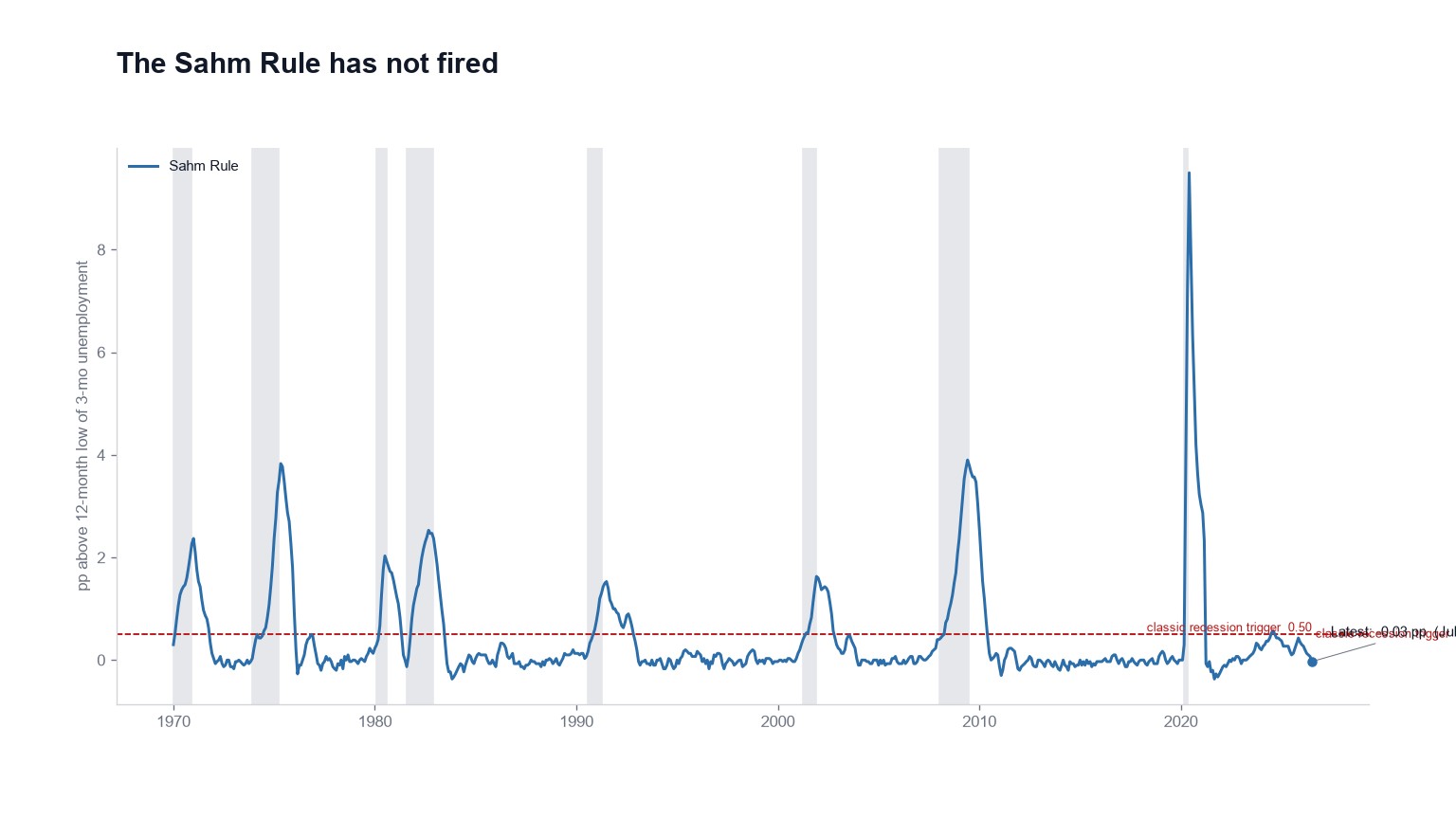
The Sahm Rule reads 0 percentage points as of July 2026, which puts it as far from its trigger as the construction allows.
The trigger is 0.50: the three-month average unemployment rate rising half a point above its low from the previous year. Claudia Sahm designed it to identify a recession while it is actually underway, and since the 1970s it has matched the start of US recessions with very few false alarms. That's a better hit rate than most macro rules manage, and it's why we show it at all.
It is still a fact about the labor market, and the labor market is not the price of stocks.
Coincident, not early
The distinction that matters here is timing, and it separates Sahm from the gauge people usually file it alongside.
The yield curve has often inverted a year or more before a downturn, which makes it a leading indicator. Sahm was built for the opposite job. It fires as unemployment is deteriorating, which places it near the official start of a recession rather than well ahead of it. Reading a low Sahm print as reassurance about next year asks a coincident measure to do a leading measure's work.
So a reading of 0 means the three-month unemployment average hasn't risen off its recent low. That is the entire content of the number. It doesn't say stocks are cheap, and it doesn't say a recession can't begin next quarter.
The rule also has a failure mode we should name rather than wait to be caught by: a sharp one-off labor shock can set it off without a genuine recession following, which is roughly what the 2020 spike did before resolving quickly.
Why it doesn't vote
Sahm can sit at 0 while valuations set records, and historically that combination has been ordinary rather than strange. A measure that stays silent through the exact conditions we're trying to detect can't help detect them, which is why the series doesn't vote in the composite.
A real climb toward 0.50 would change our reading of the cycle, and we'd say so plainly when it happened. It still wouldn't be a CAPE print.
For now the jobs side is quiet and the price side isn't. The unemployment rate is 4.1%, which is unremarkable for an expansion. A normal labor market has never once turned a 42× market into a 17× one, and nothing on the homepage will suggest otherwise while Sahm stays below 0.50.