How the 93% is calculated
August 18, 2026
The overvaluation probability is 93% as of August 28, 2026. No machine learning produced that number, and no weighting scheme quietly favors whichever gauge happens to be shouting loudest this month.
Here is the whole calculation. Take each valuation and sentiment gauge and convert it to a z-score against its own trend. Flip the two where a low reading is the bad one, Excess CAPE Yield and the VIX, so that "more overvalued" always points the same direction. Run each z-score through the normal curve to get a percentile. Average the ten and round.
That's the model. If it seems too simple to be a model, that's the point of publishing it.
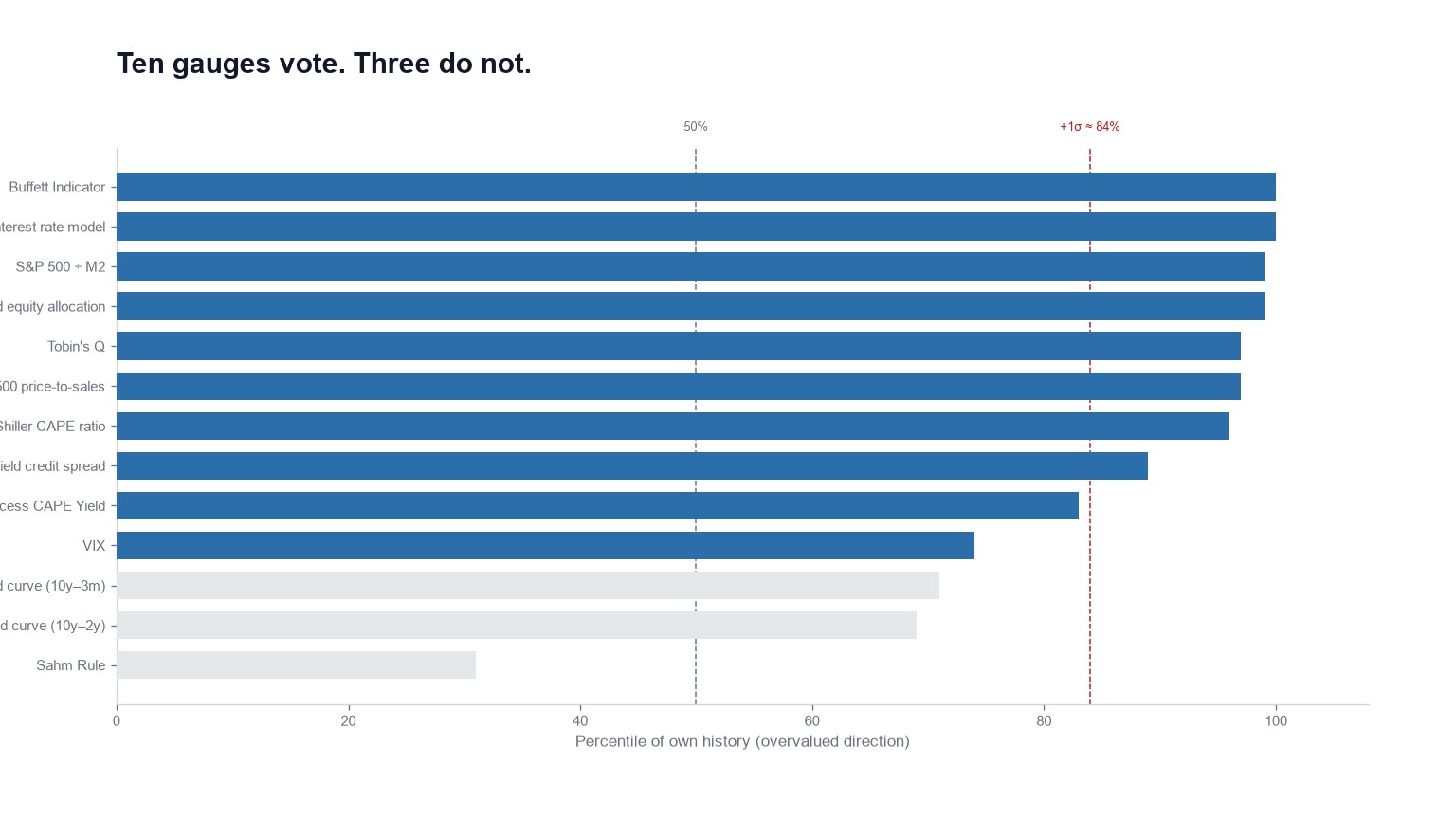
Who votes and who doesn't
Ten gauges vote: CAPE, ECY, Buffett, Tobin's Q, S&P ÷ M2, price-to-sales, the interest rate model, VIX, high-yield spreads and household equity.
Three don't: both yield curves and the Sahm Rule. They stay on the page as cycle context, and we've written up the reasoning separately.
One feature of the method reliably confuses people, so it's worth stating plainly. A gauge can carry a Fair Value badge and still push the average up, because the percentile climbs continuously while the badge only changes at a discrete threshold near +1σ, or about 84%. ECY is the example: Fair Value, and 83%. Just under the line.
The VIX is Neutral at 74%. Buffett and the interest rate model are both pinned at 100%. The 93% is the average of all ten, not an echo of the loudest.
Equal weighting is a choice
It treats the VIX as exactly as important as the Buffett Indicator, which is arguable, and people do argue it. We think the objection is fair.
Our answer is that every alternative we tried required picking weights we couldn't defend to a reader. Given a choice between being obviously crude and being quietly clever, we'd rather be crude in public, where you can see the method and disagree with it.
The homepage verdict is the simpler cousin of the same calculation: do most of those ten read Overvalued or Strongly Overvalued? Eight of ten currently do.