Mortgage rates are back to normal. Prices are not.
September 1, 2026
Housing affordability is prices, rates, and incomes. That's the whole formula. People keep pointing at the middle term.
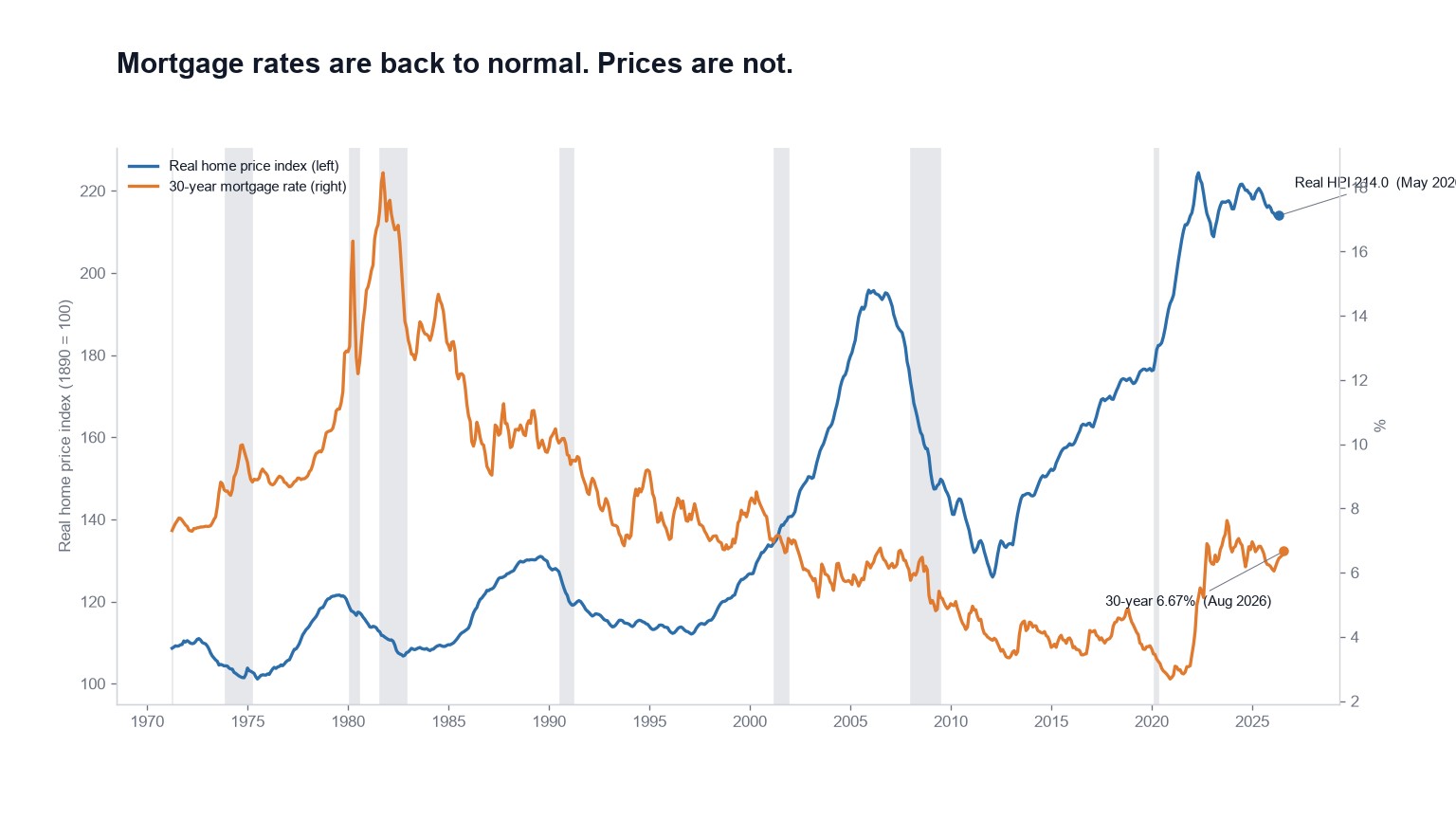
Freddie Mac's 30-year fixed averaged 6.66% the week ending August 27, 2026. The same survey, which starts in April 1971, averages 7.68%. The 1970s averaged 8.90%, the 1980s 12.71%, the 1990s 8.12%. Today's print is ordinary. The 3% to 4% rates of 2020 and 2021 were the episode this survey had never recorded until after 2008.
The bar we'd actually defend
Robert Shiller's real home price index sits at 213.96 as of May 2026. Against the 1890–2026 year-weighted mean of 113.57, that is 88% rich. We don't grade CAPE against 1871, and we shouldn't grade houses against 1890 either. A century of farmhouses and streetcars is not a fair yardstick for a market of zoning codes and 30-year amortizing debt.
Against a trailing 30-year average of 167.33, the same index is still 27.9% rich. That's the version of the claim we'll stand on. Cheap mortgages let buyers pay those prices. The mortgages are no longer cheap, and the national price has barely moved.
Average hourly earnings of all private employees were up 3.15% in July from a year earlier. That's not the 7% to 9% wage growth that carried housing through the high-rate 1970s and 1980s. Incomes are not going to grow the country into these prices on any schedule that helps a buyer this year.
The rates alibi
We already ran this argument for stocks. For a decade, low yields were supposed to justify a high multiple. The 10-year came back near 4.6% and CAPE is still 42.17×. Housing is the same sentence with different nouns.
The strongest objection is lock-in, and it's real. An owner sitting on a 3% mortgage is not a forced seller. Transaction volume can stay depressed for years while the printed index barely budges, and a national number hides metros that have already given back a lot of the gain. We don't have a housing gauge on this site, and we aren't about to average Austin and the Northeast into one verdict.
What the national series still shows is narrower. The financing term in the affordability formula normalized. The price term did not.