The rates argument has run out of rates
July 27, 2026
For about ten years, every argument about expensive stocks ended in the same place. Rates were near zero, discount rates were low, and a high multiple was just arithmetic.
It was a reasonable argument. It depended on low rates.
The 10-year Treasury now yields around 4.6%, and CAPE is still 42.17×. The argument survived the thing it was built on.
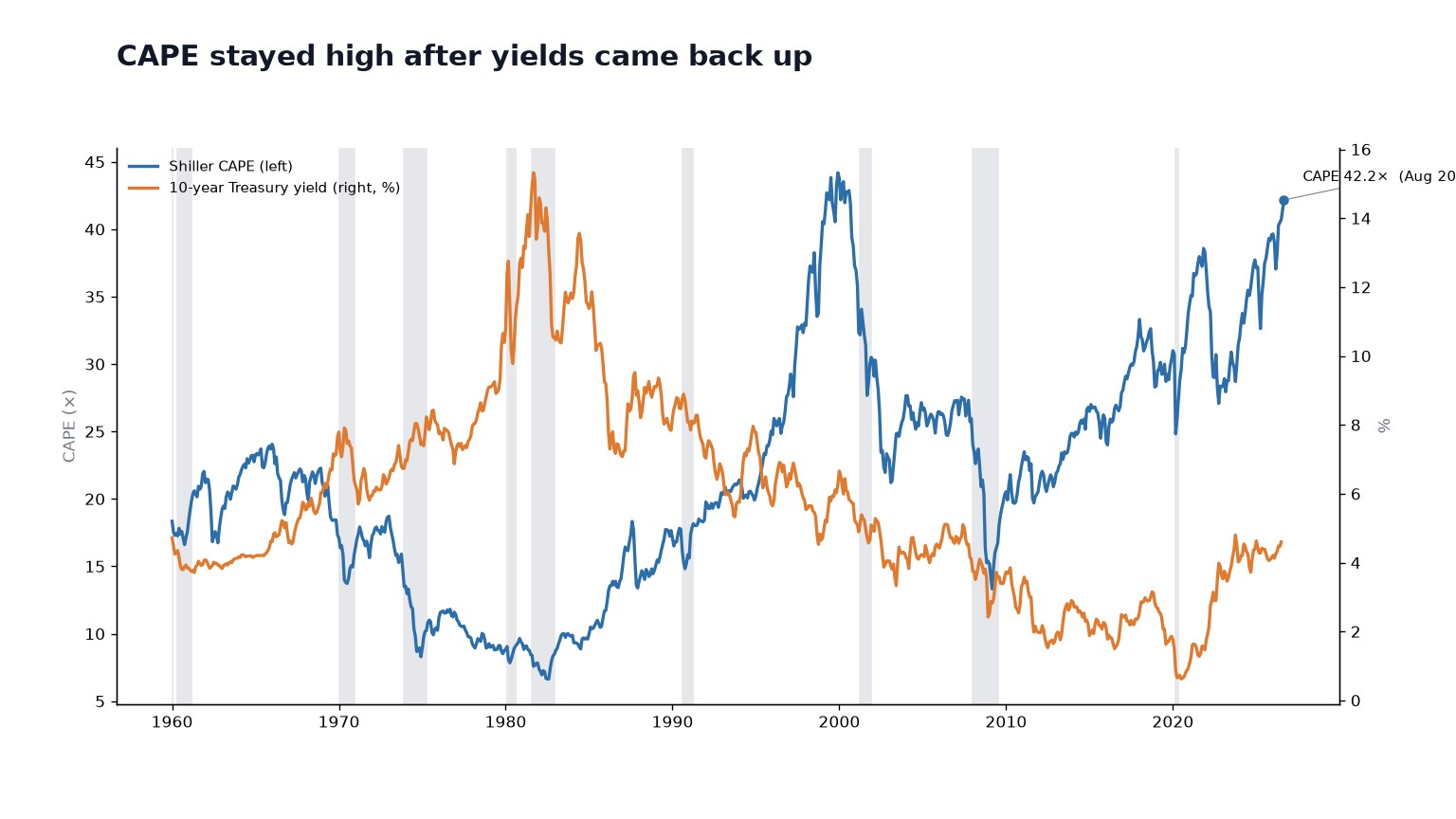
Putting the tension in one number
The interest rate model measures how far the real S&P sits from its own trend, then subtracts how far the 10-year sits from its long-run average. Stocks minus rates, both in standard deviations.
On August 28, 2026 that came out at 4.15σ, which we grade Strongly Overvalued. A reading near zero would mean the market's distance from trend roughly matches where yields sit against their own history. It isn't near zero.
Why this runs alongside ECY
Excess CAPE Yield compares an earnings yield to a real bond yield. The interest rate model compares two positions instead, which is a different question, and the page includes a scatter of the two z-scores so you can see where the current print falls.
They can disagree, and right now they do. ECY sits at Fair Value on 1.07 percentage points while the rate model reads 4.15σ. One is looking at ten years of smoothed earnings, the other at how far the price index itself has run, and there's no reason those have to agree.
Both low rates and high stock prices push the composite up. Rates are no longer low the way 2021 was low, and stocks are still high. The 4.15σ is what's left after netting the two.
People made this argument in 1999 too
They also had a rates story then, and they kept telling it right up until they couldn't.
We're not claiming 4.6% makes 42× impossible. Rates could fall again, or earnings could grow into the multiple, and either would change the picture. What we are claiming is narrower: the bond market has stopped doing the work people assigned it when the 10-year paid 1%. If something still justifies the multiple, it has to be something else.
The gauge and the scatter are on the interest rate model page.