Households already bought
August 21, 2026
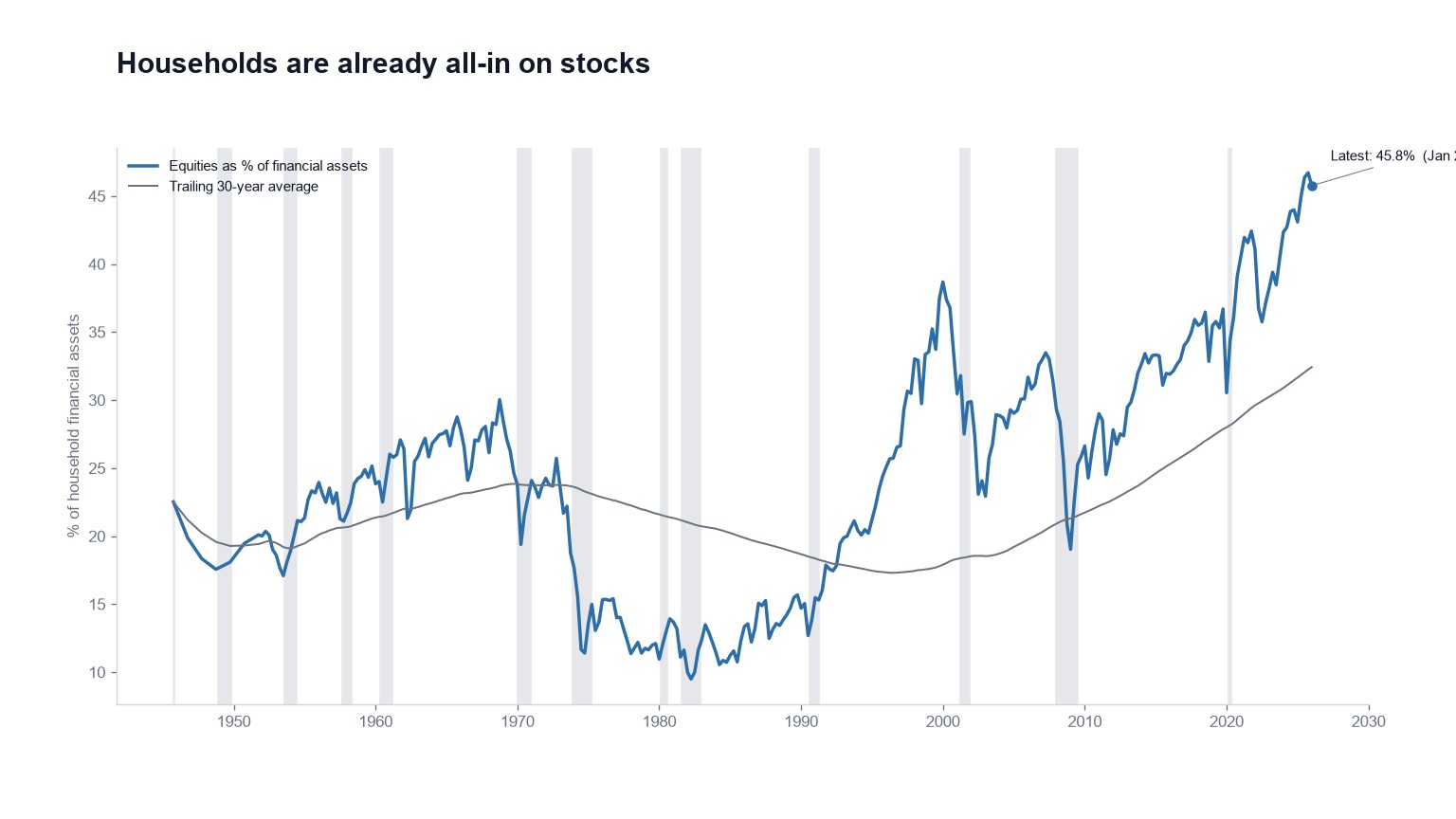
The latest Z.1 release puts household equity allocation at 45.8%. That's the share of financial assets held by households and nonprofits that sits in corporate equities, owned directly or through funds. We grade it Strongly Overvalued.
The distinction worth drawing is between sentiment and positioning. A survey tells you what people say about the market. This series tells you what they already did about it, which is harder to change and harder to misreport.
And they've already done it. When the public is this heavily committed to equities, there's less money left to bid prices higher and considerably more household wealth exposed if prices fall.
Read the peaks and troughs
The series spiked near the 2000 top and again through 2021. Its deepest troughs line up with the panic lows, when households had been frightened into cash and Treasuries and equity allocations fell by default as prices dropped.
So a high reading carries no information about mood. Households at 45.8% might be nervous about the market, and it wouldn't change the number. They own it either way.
That's why the series sits with the VIX and junk spreads on the sentiment row of the overvaluation probability, where it currently registers as a 99th-percentile crowding signal. The wealth-effect note covers the other half of the same arrangement, since the households holding these shares are the ones whose spending moves GDP when the portfolio marks up.
Why the baseline moves
Grading 45.8% against a mid-century average would overstate the case badly, and we don't do it.
401(k)s exist now. Index funds cost almost nothing. Fifty years of equity culture happened, and every one of those changes raised what counts as a normal household allocation. A benchmark that ignores them isn't measuring froth, it's measuring the passage of time.
So we grade against a trailing 30-year average, which lets the bar rise with the regime. We make the same choice for CAPE and Tobin's Q, and the logic is the same each time: raise the bar honestly, then see whether the current reading still clears it.
At 45.8%, it clears the raised bar by a wide margin.
Read the number next to the valuation gauges on the homepage rather than on its own. Whatever else is true, households are not sitting on the sidelines waiting for an entry point.