What a VIX of 14 actually tells you
August 14, 2026
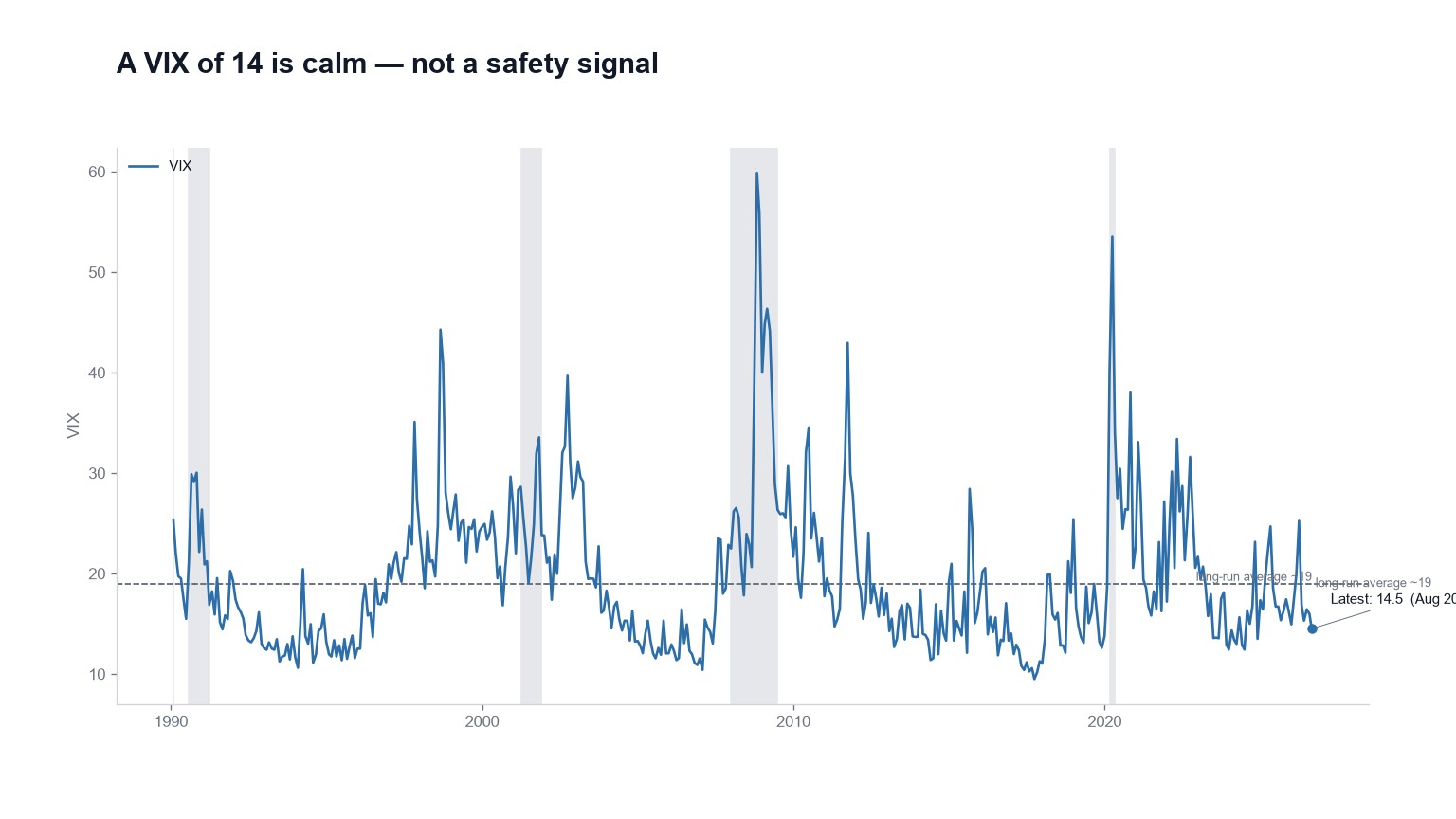
The VIX closed at 14.51 on August 27, 2026, against a long-run average of about 19. We grade that Neutral, which is the honest answer. It's not a crash warning and it's not an all-clear.
What the number measures is narrow and worth being precise about. The VIX is derived from options prices, so it tells you what traders are paying to insure a portfolio against a large move. At 14, insurance is cheap. That is the entire reading.
Cheap insurance can stay cheap for years, and usually does. What it cannot tell you is whether anything is going to happen.
This gauge reads backwards
Most of our indicators are worrying when they're high. This is one of two where the low reading is the bad one, which is why we invert it before it enters the composite.
The reason shows up in the spikes. Volatility reached the 30s in 2008 and passed 80 in March 2020, and both times it spiked because prices had already been marked down hard. Returns measured forward from those prints were better than average, not worse. The panic was the opportunity.
Today is the reverse of that setup. Almost nobody is paying for protection, while CAPE, the Buffett Indicator and household equity allocation all sit at the top of their historical ranges.
The overvaluation probability counts the VIX at the 74th percentile in the overvalued direction, which makes it one of the quieter votes. We built it that way deliberately, because a single sentiment gauge shouldn't be able to override the valuation stack.
Credit is saying the same thing
The high-yield credit spread is 2.63 percentage points against an average near 5. Lenders aren't charging much for the risk of not being repaid, and options traders aren't charging much for the risk of a crash. Two separate markets have arrived at the same shrug.
There's an innocent explanation available. Balance sheets may genuinely be strong and the cycle may genuinely be young, in which case both prices are correct and nothing follows from them. We can't rule that out from the data, and we won't pretend to.
What we can say is that this combination has shown up before, and it showed up late in the cycle rather than early. Neither series times anything on its own. Together they say risk is cheap while the assets carrying it are not.
Both numbers update on the homepage.