Lenders have stopped charging for default risk
August 17, 2026
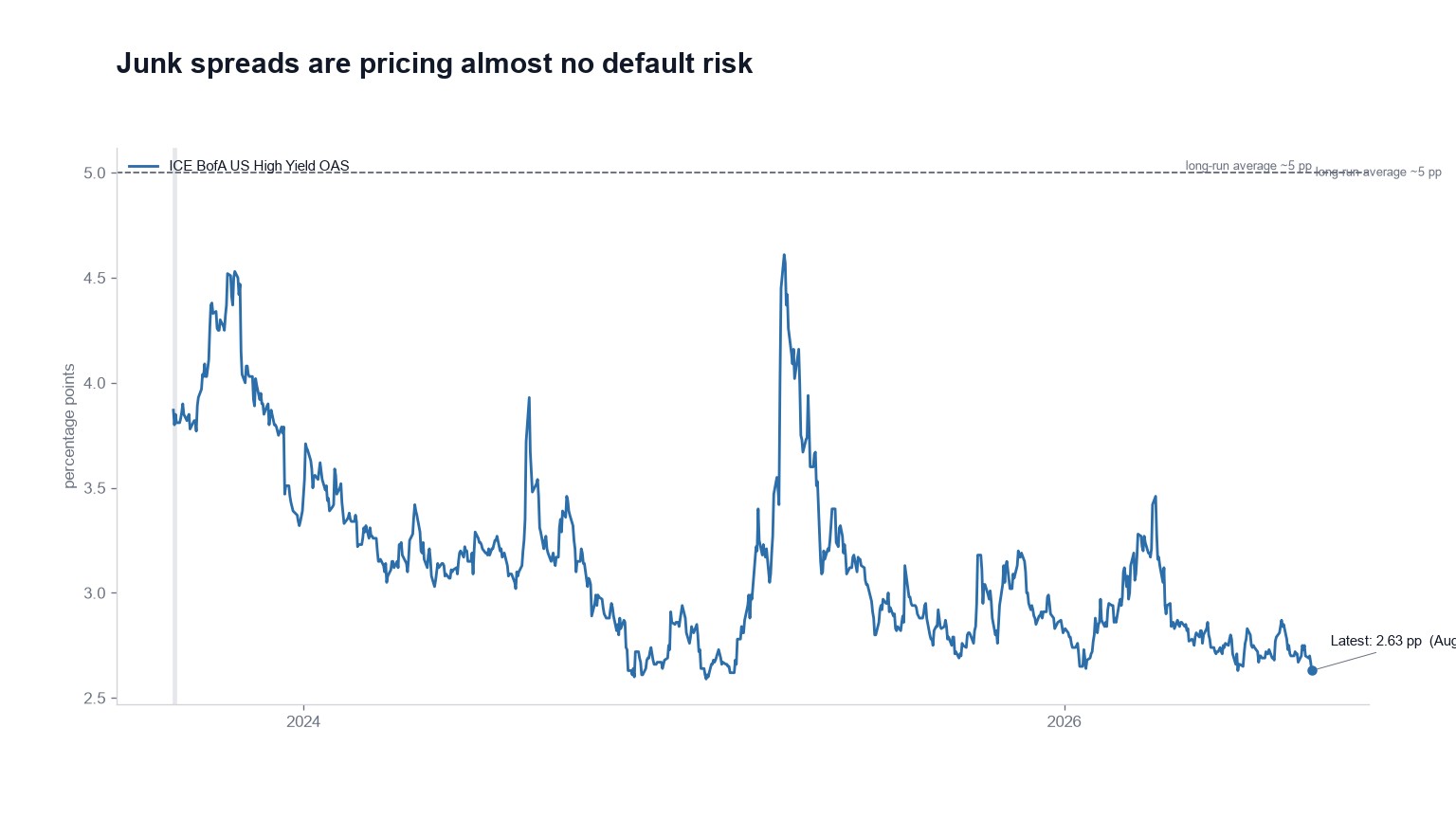
The high-yield credit spread closed at 2.63 percentage points on August 27, 2026. The ICE BofA index has averaged closer to 5 over its history. Spreads near 3 have marked periods of complacency, and spreads of 10 to 20 have marked crises.
We grade the current reading Overvalued, because on this gauge the small number is the worrying one.
Why tight is the warning
A junk spread is the extra yield lenders demand for holding debt issued by companies that might not pay them back. At 2.63 points, they have largely stopped asking for it.
There's an innocent version of that. Balance sheets may genuinely be clean, the cycle may genuinely be young, and default rates may stay low, in which case the spread is correctly priced and nothing follows. We can't rule it out from this series alone.
There's also a version where credit is abundant, covenants have been negotiated away, and equity volatility has gone to sleep. The VIX at 14.51 is the same shrug expressed in a different market. What we can say is that the second version looks exactly like this, and it tends to appear late in a cycle rather than early.
The inversion of the verdict follows from the history. Spreads blew out toward 20 points in 2008, and that was stress arriving after equity prices had already been hit, which is why buying into it worked. A print of 2.63 is the other end of that sequence.
Credit isn't a stock multiple
It's a fair question what a bond spread is doing in a stock valuation composite at all, since it measures the price of borrowing rather than the price of earnings.
It earns the seat because a market unwilling to price default risk is usually a market unwilling to price equity risk either. The two blind spots travel together, and neither shows up in a P/E ratio.
At the 89th percentile it's a loud sentiment vote without being as stretched as the Buffett Indicator or household equity, and it's no reason to discount either of those.
The live spread is on the homepage, where the useful distinction is that cheap credit and cheap stocks are entirely different things.