The G7 is paying 2008 rates. Stocks are not.
September 15, 2026
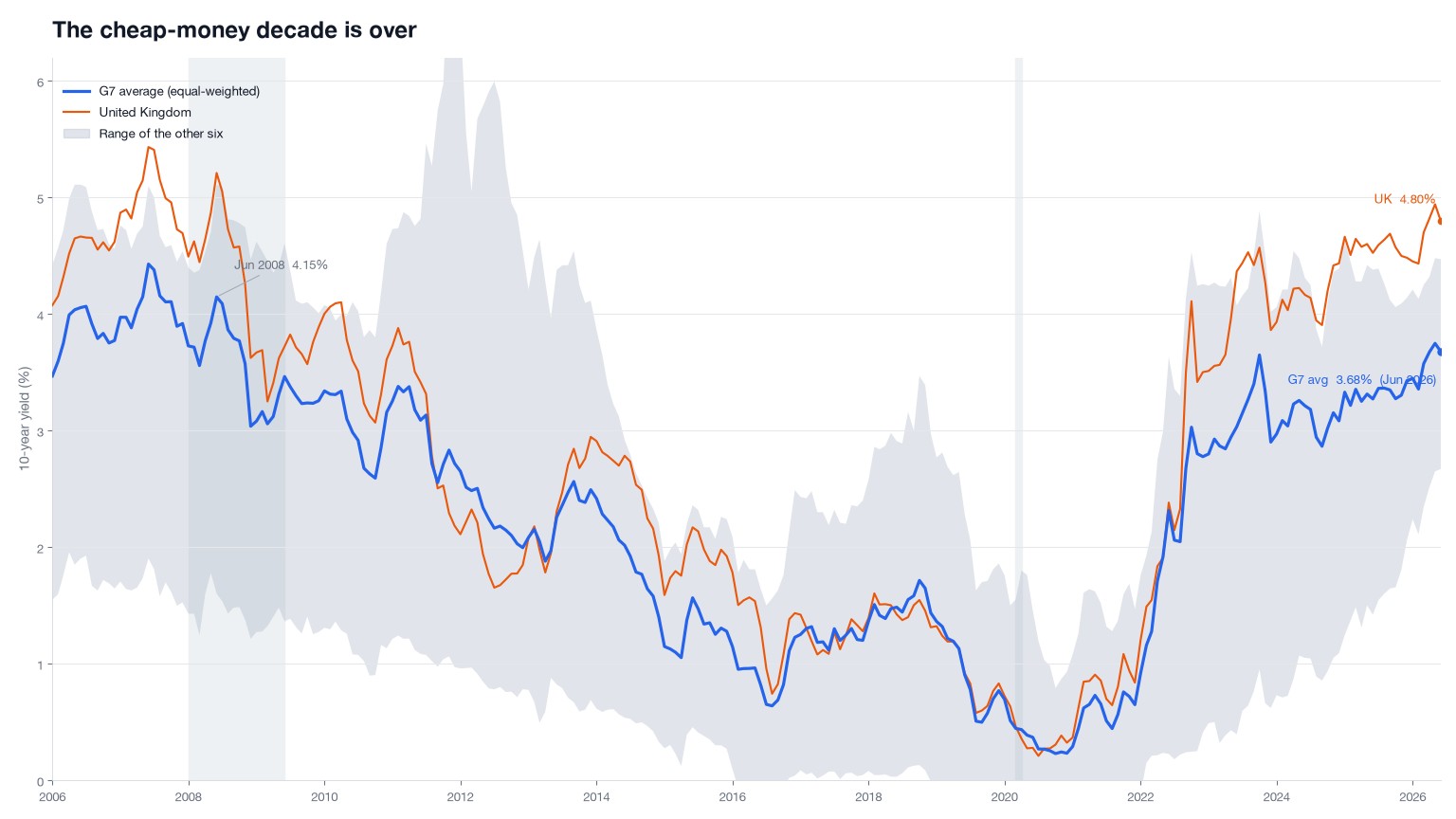
On September 9, 2026 the 10-year yields of the United States, the United Kingdom, Germany, France, Italy, Japan and Canada averaged 4.08%, equal-weighted. The OECD monthly version of that average last spent a month above 4% in June and July of 2008, at 4.15% and 4.09%. In October 2020 it was 0.23%.
The latest OECD month, June 2026, printed 3.68%. Today's 4.08% is a same-day snapshot of the seven national 10-years, not that monthly series. The direction is not in doubt.
The floor rose too
The UK gilt at 5.19% is the high. Japan at 2.88% is the low. That gap is why a single average is a blunt tool, and why the headline gets filed as an Anglo-American story.
The last four years lifted the floor as well as the ceiling. Germany's 3.38% is the highest since 2011. Japan spent a decade near zero while the Bank of Japan pinned the curve. Canada's 3.81% and France's 4.25% are not crisis prints. They are also not 2021. The cheap-money club did not lose a member. It closed.
The rates alibi, again
We already ran this argument on the US 10-year. Low yields were supposed to justify a high multiple. The Treasury 10-year is 4.81% in that same September 9 snapshot. CAPE is 41.41×. The interest rate model reads 3.93σ.
The G7 average is the same sentence with a wider noun. American companies earn all over this group. A discount rate that rose in one reserve-currency market is a local story. A discount rate that rose in all seven is the regime the 2010s argument was built on, running in reverse.
The strongest objection is that a yield can rise because growth or inflation news got better, so the higher rate is part payoff. That part is true, and it is why we do not treat every uptick in GS10 as the same input. What the last year added is issuance, runoff of central-bank books, Japan off yield-curve control, and a fiscal bid at the long end. Those move the term premium.
We don't run a G7 yield gauge. What we can say is narrower. The bond market that was supposed to keep equities expensive has stopped doing that work in every G7 capital at once. If 41× still has a justification, cheap G7 money is not it.